

Dear Editor,
The digital era has reshaped how families seek and consume health information, and pediatrics is no exception. Parents frequently turn to the internet and social media before and after consultations – to fact-check, seek reassurance, or find community –, yet this environment is rife with misinformation and non-expert content.1 Meanwhile, clinical visits remain time-limited and medically focused, offering little room to address digital health questions or misconceptions. This mismatch underscores the urgent need for pediatricians to extend their communication role beyond the clinic, into digital spaces where families already navigate.
A growing body of evidence shows that online health misinformation is pervasive and harmful, especially on widely used platforms. At the same time, many parents lack the digital literacy needed to evaluate such content critically.2,3 Pediatricians are uniquely positioned to act as trusted digital communicators; however, training in health communication is rarely incorporated into formal curricula, and even more so when it comes to digital communication.4,5 This is a missed opportunity, as clinicians who share accurate, accessible content online can effectively counter misinformation, enhance caregiver confidence, and support healthier behaviors at home.
Digital media offers substantial potential: podcasts, short videos, messaging, and e-health apps can deliver evidence-based education in formats families use daily.6,7 Reviews indicate that digital health interventions tailored to children and adolescents can effectively support behavior change, improve engagement, and enhance outcomes, although maintaining participation and addressing equality remain challenges.7 Still, several barriers limit their broader implementation, including a lack of provider training, time constraints, and the risk of oversimplification.8 Institutional infrastructure and ethical guidance are essential to safeguard credibility, confidentiality, and quality (Fig. 1).
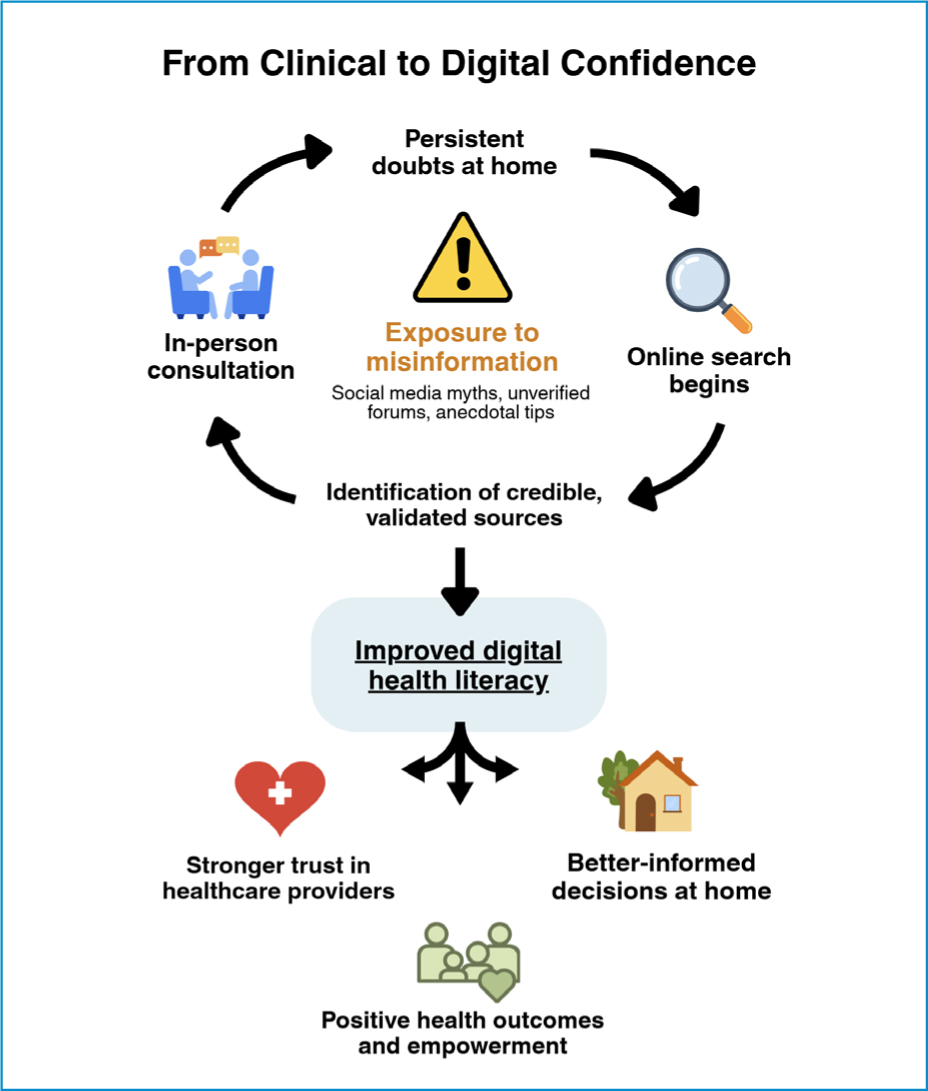
Figure 1. Flowchart illustrating the caregiver pathway from consultation, persistent doubts, and online search, through the risk of misinformation and identification of validated sources, to improved literacy, trust, and decision-making.
Our experience illustrates both opportunities and complexity. Over the past year, our team launched Saber Está no Ar, a hospital-based pediatric podcast designed to support caregivers with accessible, evidence-based content. Since September 2024, it has reached over 1800 listens, with most listeners identifying as female (57.8%) and aged 35-44 years. Episodes are released weekly and cover general pediatrics topics, aiming to clarify misconceptions through contributions from pediatricians and other healthcare professionals. The most listened-to episodes focus on practical concerns frequently raised by caregivers, such as healthy eating habits, breastfeeding, complementary feeding, oral and nasal hygiene, sun protection, screen exposure, fever, and school-exclusion illnesses.
Alongside opportunity comes ethical responsibility. The ethical principles that govern clinical practice – such as confidentiality, accuracy, and professionalism – also apply in the digital environment. Social media profiles that share health information, especially those linked to healthcare professionals or institutions, should be clearly identified, transparent, and, ideally, verified. This helps distinguish trustworthy sources from misleading or non-expert content. While some professional bodies have issued recommendations for ethical digital conduct, formal and widely adopted frameworks remain scarce. Scientific societies and regulatory organizations must play an active role in defining standards, accreditation processes, and best practices to ensure digital health communication is safe, responsible, and evidence-based.9,10
When healthcare systems emphasize prevention and community engagement, pediatricians have a clear role to play, extending their influence into familiar digital channels to meet caregivers where they are. To achieve this effectively, we propose two priorities: incorporate training in health communication and digital media literacy into pediatric curricula and continuing education; and develop institutional and professional guidelines to standardize quality, ethics, and accessibility. These steps can help pediatric providers harness digital media thoughtfully, responsibly, and equitably.
We hope these reflections stimulate discussion on incorporating digital communication skills and ethical standards into pediatric practice. Enhancing these efforts will ensure that innovation improves, rather than undermines, trust and health outcomes in an increasingly connected world.
Author contributions
T. Santos Trindade: design, methodology, validation, writing (original draft), and visualization. M. Costa: supervision, writing (review and editing), and project coordination. V. Monteiro: supervision, writing (review and editing), resources, and departmental support. T. Pinheiro: supervision, methodology, writing (review and editing), and project coordination. All authors have read and approved the final version of the manuscript.
Funding
None.
Conflicts of interest
None.
Ethical considerations
Protection of humans and animals. The authors declare that no experiments involving humans or animals were conducted for this research.
Confidentiality, informed consent, and ethical approval. The study does not involve patient personal data nor requires ethical approval. The SAGER guidelines do not apply.
Declaration on the use of artificial intelligence. The authors declare that no generative artificial intelligence was used in the writing of this manuscript.
